
They Spent Millions to Stop a Label. Ask Yourself Why
I’m going to tell you how I ended up here, because I think it matters.
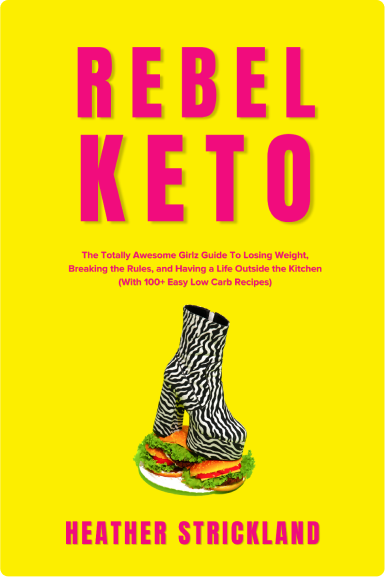
I lost 150 pounds. That’s the headline version. The real version is that I spent years unlearning everything I’d been taught about food – the low-fat lies, the sugar industry’s fingerprints on the dietary guidelines, the way an entire generation was sold a version of “healthy” that was making us sick. I wrote a whole book about it. Rebel Keto was my way of pulling back the curtain on the conspiracy that started in the 1980s, when the sugar industry paid scientists to blame fat for everything and rewrote the rules of American nutrition.
But losing the weight was only the beginning of what I started to see.
I became a certified health coach. I started reading labels – not just for macros, but for the ingredients themselves. And then I became an autism mom, homeschooling my son, managing his meltdowns, his sensory needs, his speech therapy, his ABA therapy, his GI issues. And I started reading labels differently.
Not just what’s in this? But what is this doing to him?

That question changed everything. And now, Texas just made it the law.
The Label They Don’t Want You to See
On June 22, 2025, Texas Governor Greg Abbott signed Senate Bill 25 into law. It’s called the “Make Texas Healthy Again Act,” and it requires something so simple it’s almost embarrassing that it didn’t exist before:
A warning label.
Starting January 1, 2027, any packaged food sold in Texas containing any of 44 specific ingredients must display this statement in a prominent, high-contrast location on the package:
“WARNING: This product contains an ingredient that is not recommended for human consumption by the appropriate authority in Australia, Canada, the European Union, or the United Kingdom.”
Read that again. Not recommended for human consumption. By the countries we consider our closest allies and peers. On products sitting on American shelves right now. On the snacks in your pantry. On the cereal you fed your kids this morning.
This is the first law in the United States to require warning labels based on what foreign regulators have determined about food ingredients – not just nutritional content like sugar or fat, but the actual chemical compounds added to our food. It passed with bipartisan support. Robert F. Kennedy Jr. endorsed it. It was signed into law.
And the food industry immediately sued to stop it.
The Industry’s Response Tells You Everything
On December 5, 2025, less than six months after the bill was signed, the American Beverage Association, the Consumer Brands Association, the National Confectioners Association, and the Food Industry Association filed a federal lawsuit to block the label requirement.
Not the education provisions. Not the school nutrition requirements. Just the label.
Think about that for a second. These companies aren’t being asked to remove a single ingredient. They’re not being fined. They’re not being shut down. They’re being asked to tell you what’s in the product you’re already buying. And they went to federal court to make sure you don’t see that information.
Their argument? The label violates their First Amendment rights because it forces them to put a “misleading” message on their products. They claim some of the 44 ingredients aren’t technically “banned” in those foreign countries – just restricted or limited.
And in February 2026, a federal court granted a preliminary injunction, temporarily blocking enforcement while the case plays out. The food industry got what it wanted, for now.
But here’s the question nobody in that courtroom asked: if these ingredients are so safe, why are you spending millions of dollars to make sure nobody has to put a label on them?
The 44 Ingredients (And What They’re Doing to You)
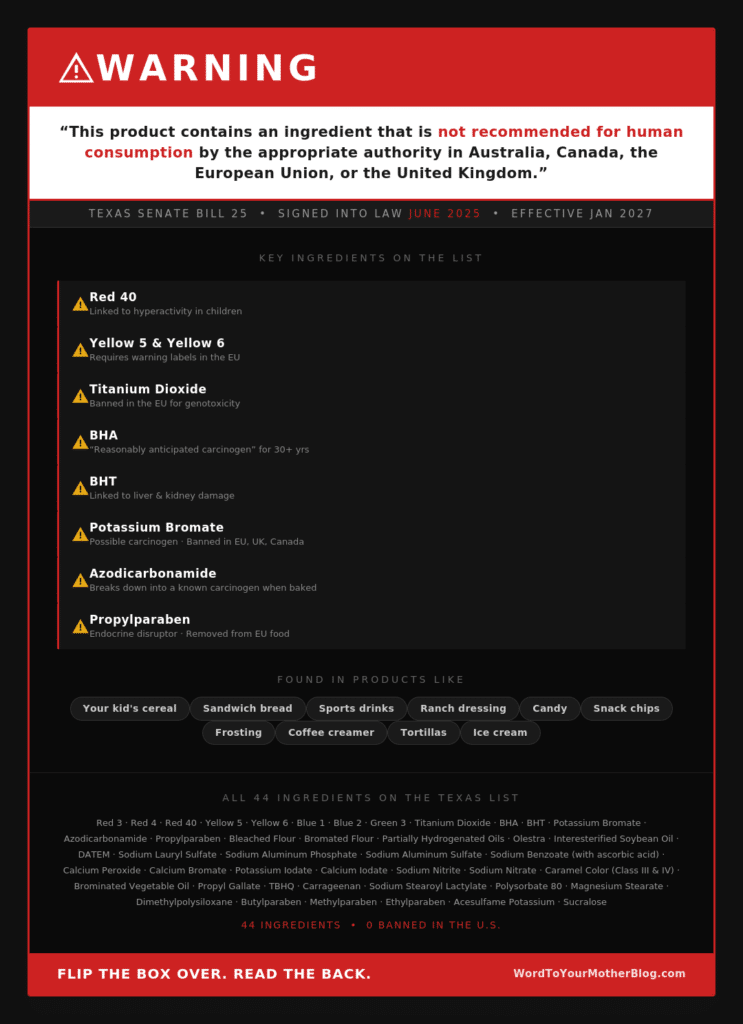
The list includes artificial dyes, preservatives, processing agents, and chemical additives. Many of them have been in our food supply for decades. Some have been linked to cancer. Others to hormone disruption, behavioral issues in children, organ damage, and DNA changes. Here are some of the most common ones – the ones you’re most likely eating or feeding your family right now.
Artificial Food Dyes (Red 40, Yellow 5, Yellow 6, Blue 1, Blue 2, Green 3, Red 3)

Found in: candy, cereal, sports drinks, snack chips, frosting, condiments, medications
These petroleum-based dyes serve no nutritional purpose. They exist solely to make food look more appealing. A review of 27 clinical trials found a clear connection between synthetic food dye exposure and behavioral problems in children, including hyperactivity and attention issues, in kids both with and without pre-existing conditions. The EU requires warning labels on these dyes. The FDA does not. Red 3 was banned from cosmetics in 1990 because it caused cancer in animals, but it stayed legal in food until January 2025 – 35 years later.
BHA and BHT (Butylated Hydroxyanisole & Butylated Hydroxytoluene)

Found in: cereals, chips, crackers, granola bars, baked goods, chewing gum
These synthetic preservatives prevent oils from going rancid. The National Toxicology Program has classified BHA as “reasonably anticipated to be a human carcinogen” for over 30 years. The EU classifies it as a suspected endocrine disruptor that interferes with hormone systems. BHT has been linked to liver and kidney damage in animal studies and is considered a respiratory irritant. Both have been in our food supply since the FDA labeled them “generally recognized as safe” in 1958. That determination has never been formally reviewed with modern science.
Titanium Dioxide

Found in: candy, coffee creamers, frosting, salad dressings, anything bright white
Used to make food look whiter and brighter, titanium dioxide was banned in the EU in 2022 after the European Food Safety Authority concluded it could no longer be considered safe. The concern is genotoxicity – the potential to damage DNA and chromosomes. It breaks down into nanoparticles that accumulate in the body after ingestion. The International Agency for Research on Cancer classifies it as “possibly carcinogenic.” The FDA still allows it.
Azodicarbonamide (ADA)

Found in: commercial breads, buns, pastries, tortillas
ADA is a dough conditioner and whitening agent. It’s also used as a foaming agent in yoga mats and shoe soles. During baking, ADA breaks down into urethane, which is classified as a known human carcinogen. Banned in the EU and many other countries. Still in your sandwich bread.
Potassium Bromate

Found in: flour, baked goods, bread
Added to flour to strengthen dough, potassium bromate is classified as a possible human carcinogen by the International Agency for Research on Cancer. Animal studies have shown it causes tumors and kidney damage. Banned in the EU, UK, Canada, and many other countries. The FDA expressed concerns about it in 1991 and asked bakers to stop using it voluntarily. That was 35 years ago. It’s still in American flour.
And the Rest of the List
The full list of 44 includes bleached flour, bromated flour, propylparaben (an endocrine disruptor removed from EU food in 2006), partially hydrogenated oils, olestra, interesterified soybean oil, DATEM, sodium lauryl sulfate, and many more. Some of these are in products you’d never expect – tortillas, salad dressings, ice cream, soap.
If you’ve been dealing with chronic inflammation, unexplained digestive issues, hormonal imbalances, skin reactions, brain fog, or watching your child struggle with hyperactivity, focus, or behavioral regulation – it is worth looking at what’s on the label. Not just the nutrition facts. The ingredients.
Why It Took This Long
If you wrote Rebel Keto with me or followed my work on the sugar industry conspiracy, none of this will surprise you. The playbook is the same. The players are the same. Only the ingredients have changed.
The GRAS Loophole
In 1958, Congress created a designation called “Generally Recognized as Safe” aka: GRAS. It was meant for common ingredients like flour and vinegar. Instead, it became a backdoor for thousands of chemicals to enter the food supply without FDA review. Companies can convene their own panel of experts, declare their additive GRAS, and either notify the FDA or skip that step entirely and start adding it to food. Nearly 99% of new chemicals introduced into the American food supply between 2000 and 2021 came through GRAS notices, not FDA review.
The foxes have been guarding the henhouse for 67 years.
The Precautionary Principle vs. “Prove It’s Killing Us”
Europe operates on the precautionary principle: if there’s reasonable doubt about safety, you don’t approve it until the manufacturer proves it’s safe. America flips that entirely. Here, chemicals are innocent until proven guilty. The burden is on regulators – underfunded, understaffed regulators – to prove harm. And proving harm takes years of studies, political will, and surviving industry lawsuits. Meanwhile, your kids keep eating the stuff.
In 2008, the European Food Safety Authority launched a comprehensive re-evaluation of every food additive on the market using current science. Many old approvals didn’t hold up. The FDA has never done anything comparable.
The Lobbying
Every time reform has been attempted, the food industry has mobilized to kill it. When the Natural Resources Defense Council pushed for GRAS reform in 2013, industry trade groups shut it down. When California tried to ban titanium dioxide, the effort was weakened. When the FDA decided to revoke the GRAS status of partially hydrogenated oils in 2013, the rule didn’t take effect for five more years.
The sugar industry did this in the ’80s. The additive industry is doing it now. Same strategy, same money, same result: Americans get the version of food that other countries won’t allow.
What I See Now That I Didn’t See Before
When I started my weight loss journey, I was focused on macros – carbs, fat, protein. When I became a health coach, I started looking at food quality. When I became a mom to a child with autism, I started looking at everything.
The artificial dyes linked to hyperactivity and behavioral issues in children? My son eats those. The preservatives flagged as endocrine disruptors? Those are in his snacks. The additives that accumulate in the body and may cause inflammation and GI problems? He’s had colon issues. I’m not saying these chemicals caused his autism. I’m saying nobody can tell me with certainty that a lifetime of exposure to substances banned in other countries isn’t making things harder for him.
And that uncertainty – that “we don’t know for sure” – is exactly the gap the food industry has been exploiting for decades.
I wrote about the sugar conspiracy in Rebel Keto because I believed people deserved to know the truth about what they’d been sold. I’ve written about labels that lie on this blog because I believe information is the first step to change. This post is the same thing. It’s all connected. The sugar. The additives. The lobbying. The labels. The chronic illness. The kids who can’t focus. The moms doing both jobs, reading every label, and still not being told the full truth.
Texas tried to change that. The food industry sued. A court blocked it. But the information is out there now, and nobody can un-ring that bell.
What You Can Do Right Now
You don’t need to wait for a warning label. You don’t need the court case to be resolved. You don’t need permission from the FDA. Here’s what you can do today:
Flip the package over. Stop looking at the front. The front is marketing. The back is the truth. Read the ingredients list, not just the nutrition facts.
Learn the red flags. If you see Red 40, Yellow 5, Yellow 6, Blue 1, BHA, BHT, titanium dioxide, potassium bromate, azodicarbonamide, or propylparaben – that product would require a warning label in Texas. And it’s banned or restricted in the EU.
Choose the shorter list. You don’t have to memorize 44 chemical names. A good rule of thumb: if the ingredient list is full of words you can’t pronounce, put it back. If it has five or fewer ingredients you recognize, you’re probably fine.
Look for the same brands, reformulated. Many major brands already make versions of their products without these additives – for European markets. Some are starting to reformulate for the U.S. too. Remember to vote with your wallet.
Pay attention to your kids. If your child struggles with focus, hyperactivity, behavioral regulation, or unexplained GI issues, try eliminating artificial dyes and preservatives for two weeks. You may be surprised by what changes. I was.
Use the tools that exist. The EWG’s Food Scores database is free. Their Healthy Living app lets you scan barcodes and flag concerning ingredients. It takes 10 seconds.
Share this information. Not as fear. Not as panic. As the truth that other countries already act on and that the American food industry is spending millions to keep off your cereal box.
What’s Coming Next
The Texas case is going to trial or to appeal. Louisiana has passed its own version of the law requiring QR codes with ingredient disclosures, effective 2028. California, West Virginia, and New York are advancing their own bills. The FDA has launched a review of food additives with BHA, BHT, and ADA on the priority list. States are no longer waiting for federal action, and the food industry is in full-blown damage control mode.
This is bigger than one bill. This is the same fight I’ve been writing about since Rebel Keto – the fight between an industry that profits from keeping you uninformed and the people who are done accepting that.
I didn’t start this journey thinking about food additives. I started it trying to lose weight. Then I started trying to be healthy. Then I started trying to understand why my son’s body was struggling. And every single road led back to the same place: a food system that prioritizes profit over people, and a regulatory system that was designed to protect us but was captured by the companies it was supposed to regulate.
Texas put 44 ingredients on a list and said: tell people. The food industry said: no. A court said: not yet. But you can say: I’m going to look anyway.
Flip the box over. Read the back. That’s where the truth has been hiding this whole time – in plain sight.
If you liked this post, you may also love these health-related articles.
How To Quit Sugar Without Losing Your Mind
Plant Based Diet Meal Plan For Beginners: 21 Days of Whole Food Recipes
Weight Loss Tips That Work [The Essential Guide To Losing Weight & Keeping It Off]
Share and save on Pinterest!